 by
by Savitribai Phule Biography : Savitribai Phule stands as a monumental figure in the history of Indian social reform, often hailed as the “Mother of Indian Feminism” and the country’s first female teacher. Born in an era when education for women and lower castes was considered a radical, even sinful act, she defied every societal norm to ignite a revolution of knowledge. For a platform like Net Worth Guru, Savitribai’s “net worth” is not measured in material wealth, but in the millions of lives transformed by the schools she built and the barriers she broke.
Her journey began in the small village of Naigaon, Maharashtra, where she was born into a family of farmers. Married at the tender age of nine to Jyotirao Phule, she entered a household that would become the epicenter of India’s social awakening. Unlike the restrictive marriages of the 19th century, her union with Jyotirao was a partnership of equals. It was he who recognized her thirst for learning and took the bold step of educating her at home, eventually training her to become an educator herself.
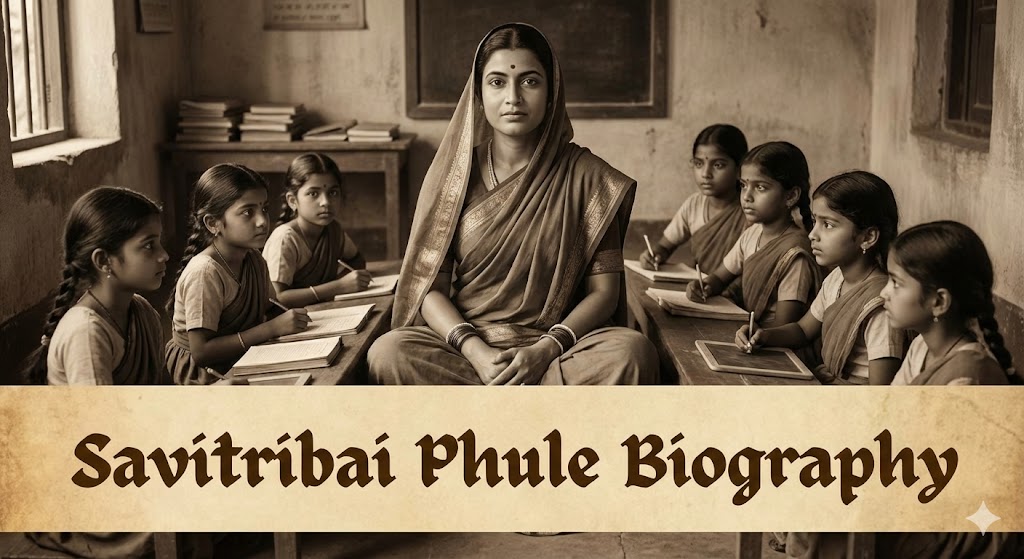
The resistance they faced was brutal. As Savitribai walked to the first school for girls at Bhide Wada in Pune, she was often pelted with stones, mud, and cow dung by orthodox groups who viewed her work as a threat to the social order. Undeterred, she famously carried a second sari in her bag, changing into clean clothes upon reaching the school to continue her lessons. This simple act of carrying an extra sari became a powerful symbol of her unwavering grit and refusal to be silenced by bigotry.
Savitribai’s legacy extends far beyond the classroom. She was a poet, a philosopher, and a fierce advocate for the rights of widows and the “untouchable” communities. From opening a well in her own house for marginalized castes to establishing a shelter for pregnant rape victims, her life was a continuous battle against injustice. This article explores the profound life of a woman who didn’t just teach lessons from books, but taught a nation how to value the dignity of every human being.
Personal Details of Savitribai Phule
| Feature | Details |
|---|---|
| Full Name | Savitribai Jyotirao Phule |
| Date of Birth | January 3, 1831 |
| Birthplace | Naigaon, Satara District, Maharashtra, India |
| Date of Death | March 10, 1897 (Aged 66) |
| Cause of Death | Bubonic Plague (Contracted while treating patients) |
| Parents | Khandoji Neveshe Patil (Father), Lakshmi (Mother) |
| Spouse | Mahatma Jyotirao Phule (Married in 1840) |
| Children | None biological; Adopted Yashwantrao (son of a Brahmin widow) |
| Notable Works | Kavya Phule (1854), Bavan Kashi Subodh Ratnakar (1892) |
| Honors | Savitribai Phule Pune University (Named in her honor in 2014) |
Who Was Savitribai Phule and How Did She Become a Teacher?
Savitribai Phule was a 19th-century social reformer who pioneered the cause of women’s education in India. Her transformation into a teacher was a collaborative effort with her husband, Jyotirao Phule. In an age where women were strictly forbidden from reading and writing, Jyotirao began teaching Savitribai at home. He provided her with primary education, and she later pursued formal teacher training at institutions run by American and Scottish missionaries in Ahmednagar and Pune.
By 1847, she had completed her training and passed her examinations, effectively becoming a qualified educator. In 1848, she and Jyotirao opened India’s first school for girls at Bhide Wada in Pune. She didn’t just serve as a teacher; she was the headmistress of the school, managing a curriculum that included mathematics, science, and social studies—subjects previously reserved only for upper-caste men. Her “how” was rooted in resilience; she treated education as a revolutionary tool to dismantle the caste system and patriarchy.
How Did She Impact Social Reform Beyond Education?
Savitribai’s social work was remarkably holistic. She realized that education alone couldn’t fix a broken society if women were being persecuted for their biological circumstances. In 1863, she established the Balhatya Pratibandhak Griha (Home for the Prevention of Infanticide). This was a safe haven where pregnant widows, who were often victims of exploitation and faced social ostracization, could deliver their children in safety and dignity.
Furthermore, she was a key figure in the Satyashodhak Samaj (Society of Seekers of Truth), founded by her husband to advocate for the rights of the depressed classes. In a radical move for the 1860s, the Phules opened the water tank in their own home to Dalits, who were then barred from using public wells. How she managed these reforms was through direct action; whether it was organizing a barbers’ strike to protest the forced shaving of widows’ heads or conducting inter-caste marriages without priests, Savitribai was always at the front lines of the struggle.
Aslo Read : Virat Kohli Biography — The Inspiring Journey of the Run Machine of India
Savitribai Phule Key Milestones and Historical Data
| Year | Milestone / Achievement | Impact |
|---|---|---|
| 1840 | Marriage to Jyotirao Phule | Started her journey toward literacy and social work. |
| 1848 | Opened First Girls’ School | Established at Bhide Wada, Pune with 9 students. |
| 1852 | Mahila Seva Mandal | Founded to create awareness about women’s rights. |
| 1854 | Published Kavya Phule | Her first collection of poems, urging people to get an education. |
| 1863 | Infanticide Prohibition Home | Created a sanctuary for pregnant widows and their infants. |
| 1868 | Opening the Family Well | Defied caste norms by sharing water with “untouchables.” |
| 1873 | Satyashodhak Samaj | Played a leading role in the movement for social equality. |
| 1897 | Ultimate Sacrifice | Died while serving plague victims in Pune. |
The Final Sacrifice and Enduring Legacy
The story of Savitribai Phule concludes with an act of heroism that defined her entire existence. In 1897, the Third Pandemic of the Bubonic Plague hit Pune. While many fled the city in fear, Savitribai and her adopted son, Dr. Yashwantrao, opened a clinic to treat the sick. At the age of 66, she was seen carrying a young plague-stricken boy on her back to the hospital. In the process, she contracted the disease and passed away on March 10, 1897.
Her legacy, however, remains immortal. In 2025, she is remembered not just on her birth anniversary (National Women’s Education Day), but through every girl in India who picks up a book. The Government of Maharashtra and the University of Pune (now Savitribai Phule Pune University) continue to honor her name as a symbol of progress and intellectual liberation. She taught the world that the “net worth” of a human life is determined by how much one gives back to the society that tried to hold them back.
Savitribai Phule Biography FAQ
Why is Savitribai Phule called the First Female Teacher of India?
She is called so because, in 1848, she became the first Indian woman to formally train as a teacher and open a dedicated school for girls in Pune, defying the prevailing social ban on female education.
What was the “Two Saris” incident?
While walking to school, orthodox critics threw mud and stones at Savitribai. She carried a second sari to change into once she reached the school, ensuring her students always saw her as a dignified and professional educator.
Did Savitribai Phule have children?
Savitribai and Jyotirao had no biological children. They adopted Yashwantrao, the son of a Brahmin widow, raised him as their own, and educated him to become a doctor.
What are her most famous literary works?
Her most famous works are Kavya Phule and Bavan Kashi Subodh Ratnakar. Her poems often focused on education, social justice, and self-reliance.
How is her birthday celebrated today?
January 3rd is celebrated across India, especially in Maharashtra, as Savitribai Phule Jayanti — also recognized as Women’s Education Day in many institutions.