 by
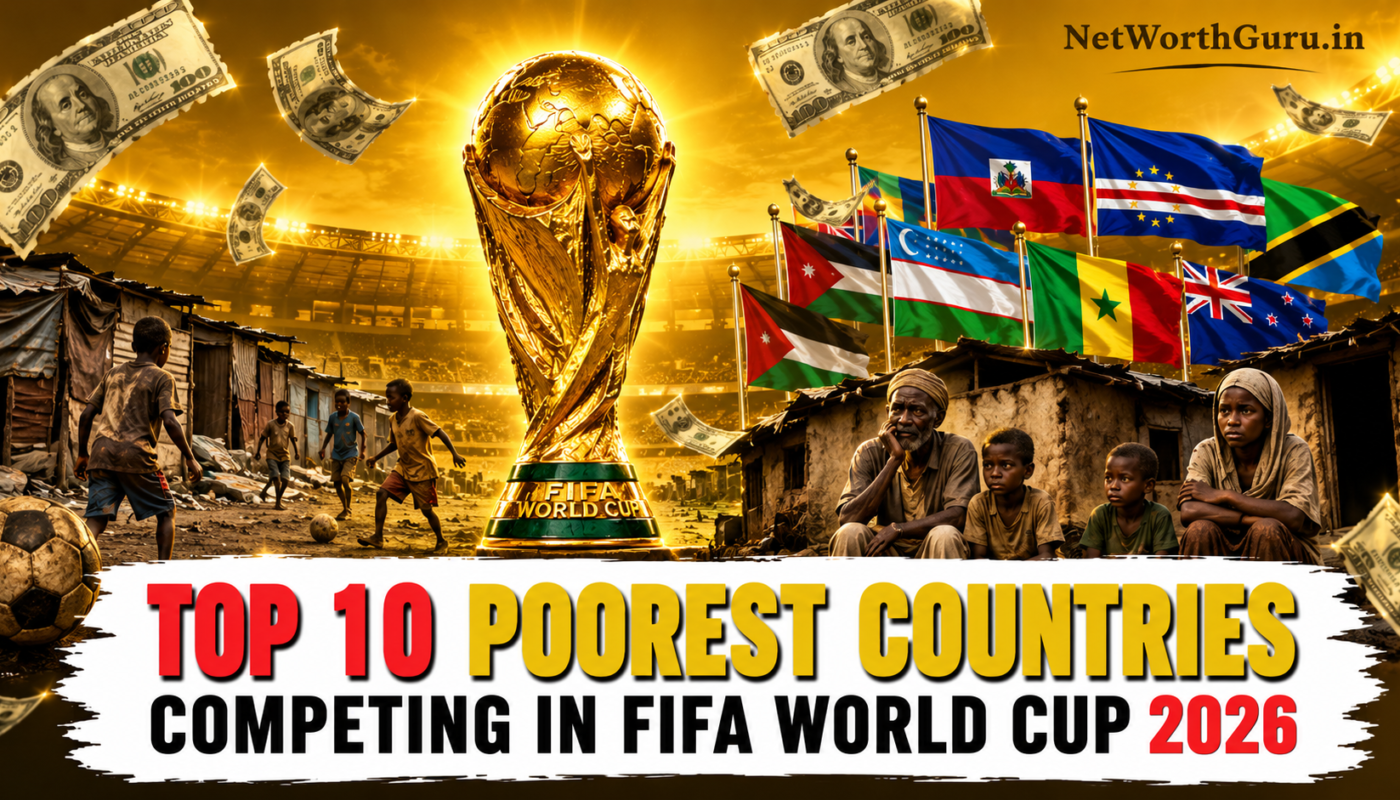
by Top 10 Poorest Countries Competing in FIFA World Cup 2026 : The FIFA World Cup 2026 is the largest, most commercially spectacular and most diverse football tournament in the history of the sport. Spread across 16 host cities in the United States, Canada, and Mexico, this expanded 48-team edition has opened the door to nations that would never have reached the World Cup stage under the old 32-team format. It is a celebration of football’s extraordinary power to transcend borders, politics, and economics — to unite nations separated by everything except their love of the beautiful game.
But behind the glamour, the billion-dollar sponsorship deals, the state-of-the-art stadiums, and the global television audiences of hundreds of millions lies a powerful and humbling truth. Several of the nations competing in North America this summer are among the poorest countries on earth. Their players have fought through unimaginable hardship, political instability, extreme poverty, and crumbling football infrastructure to earn a place on the world’s greatest stage. Their stories are not just about football — they are about human resilience, national pride, and the extraordinary ability of sport to give hope where hope is in desperately short supply.
This article ranks the top 10 poorest countries competing in the FIFA World Cup 2026, measured by GDP per capita — the most widely used international measure of a nation’s average economic output per person. We go deep into each country’s economic reality, their football journey, and what this World Cup means for people who live on less per day than most fans spend on a match-day snack.
Quick Overview Table
| Rank | Country | Confederation | GDP Per Capita (2026 Est.) | Total GDP (Est.) | UN Status |
|---|---|---|---|---|---|
| 1 | DR Congo | CAF | ~$1,122 | ~$130 Billion | Least Developed Country |
| 2 | Tanzania | CAF | ~$1,191 | ~$85 Billion | Least Developed Country |
| 3 | Haiti | CONCACAF | ~$1,176 | ~$25 Billion | Least Developed Country |
| 4 | Senegal | CAF | ~$1,900 | ~$35 Billion | Least Developed Country |
| 5 | Ghana | CAF | ~$2,500 | ~$85 Billion | Lower Middle Income |
| 6 | Ivory Coast | CAF | ~$2,700 | ~$80 Billion | Lower Middle Income |
| 7 | Bolivia | CONMEBOL | ~$3,800 | ~$45 Billion | Lower Middle Income |
| 8 | Uzbekistan | AFC | ~$2,800 | ~$110 Billion | Lower Middle Income |
| 9 | Honduras | CONCACAF | ~$3,200 | ~$35 Billion | Lower Middle Income |
| 10 | Cameroon | CAF | ~$1,800 | ~$50 Billion | Lower Middle Income |
All GDP figures are estimates based on IMF World Economic Outlook April 2026 projections and World Bank data. GDP per capita figures are nominal unless otherwise stated.
1. DR Congo — GDP Per Capita: ~$1,122
The Democratic Republic of Congo is the second largest country in Africa by landmass, the most populous French-speaking nation on earth, and one of the most extraordinarily resource-rich countries in the entire world. Beneath its vast tropical rainforest — the second largest on the planet after the Amazon — lies an almost incomprehensible abundance of natural wealth. The DRC holds an estimated $24 trillion worth of untapped mineral reserves, including the largest known deposits of coltan in the world — the mineral that powers virtually every smartphone and electric vehicle battery on the planet. It possesses enormous reserves of cobalt, copper, gold, diamonds, and timber. By any measure of natural endowment, the DRC should be one of the wealthiest nations on earth.
Instead, it is one of the poorest. With a GDP per capita of just $1,122 in 2026, the average Congolese citizen lives on approximately $3 per day — a figure that places the country firmly among the ten most economically deprived nations on earth and on the United Nations official list of Least Developed Countries. Decades of catastrophic colonial exploitation under Belgian rule, followed by a long reign of the kleptocratic dictator Mobutu Sese Seko, followed by decades of devastating civil wars that have claimed millions of lives — the DRC’s poverty is not a product of geography or lack of resources but of relentless exploitation, corruption, and conflict that has prevented its enormous natural wealth from reaching its people.
Over 60% of the population lives below the international poverty line of $2.15 per day. Healthcare infrastructure is severely underdeveloped, educational access remains deeply unequal, and political stability continues to be undermined by numerous armed groups operating across the country’s vast eastern territories. The ongoing conflict in eastern DRC has displaced millions of people and continues to create humanitarian emergencies that draw far less global attention than they deserve.
Against this backdrop, the DR Congo national football team’s qualification for the FIFA World Cup 2026 is not merely a sporting achievement — it is a moment of profound national meaning. Football is the most powerful unifying force in a country that is otherwise deeply divided by geography, ethnicity, language, and politics. The Leopards, as they are known, qualified through the CAF inter-confederation play-offs and will represent not just 100 million Congolese people but the ambitions of an entire continent in watching one of Africa’s most historically significant football nations compete at the highest level. Their players, many of whom developed their craft in European leagues, carry with them the hopes of millions of people who have very little else to celebrate.
| Economic Indicator | Data |
|---|---|
| GDP Per Capita (Nominal, 2026 Est.) | ~$1,122 |
| Total GDP (2026 Est.) | ~$130 Billion |
| Population | ~116 Million |
| Poverty Rate (below $2.15/day) | ~60%+ |
| UN Classification | Least Developed Country |
| Human Development Index Rank | 176th out of 193 |
| Main Natural Resources | Cobalt, Coltan, Copper, Gold, Diamonds |
2. Tanzania — GDP Per Capita: ~$1,191
Tanzania is one of the most beautiful countries in the world. Home to Mount Kilimanjaro — Africa’s highest peak — the Serengeti National Park, the Zanzibar archipelago, and the Ngorongoro Crater, Tanzania possesses a natural landscape that draws hundreds of thousands of tourists annually and has made it one of Africa’s most recognisable international destinations. Yet for the vast majority of Tanzania’s 65 million people, the country’s extraordinary natural beauty translates into remarkably little economic opportunity. With a GDP per capita of approximately $1,191 in 2026, Tanzania ranks among the world’s poorest nations and sits on the United Nations Least Developed Countries list.
Agriculture remains the backbone of the Tanzanian economy, employing approximately 65% of the working population and accounting for a significant portion of export revenues. Tea, coffee, cashews, cotton, and sisal are the country’s primary agricultural exports, but the sector is highly vulnerable to climate shocks — droughts and floods regularly devastate harvests and push rural communities deeper into poverty. Infrastructure development has been a priority for the government in recent years, with significant Chinese investment in railway and road construction, but the benefits of this investment are taking time to reach the majority of the population.
Tanzania’s qualification for the FIFA World Cup 2026 is truly historic — it is the country’s first ever appearance at a senior men’s World Cup, a milestone that has generated extraordinary excitement across the nation. The Taifa Stars, as the national team is known, battled through the challenging CAF qualification process against established African football nations to earn their place in North America. For a country where the average person earns just over $3 per day, the cost of attending the World Cup in North America is utterly prohibitive for most Tanzanian fans. A return flight from Dar es Salaam to New York alone costs the equivalent of several months of average wages, meaning the tournament will be experienced primarily through television and radio broadcasts — media that transcend the economic barriers that prevent direct participation.
Their players represent a generation that has grown up watching African football rise on the world stage and who believe, with genuine conviction, that Tanzania’s time has arrived. Their World Cup debut is a story of collective determination that the entire African continent has embraced with pride.
| Economic Indicator | Data |
|---|---|
| GDP Per Capita (Nominal, 2026 Est.) | ~$1,191 |
| Total GDP (2026 Est.) | ~$85 Billion |
| Population | ~65 Million |
| Poverty Rate (below $2.15/day) | ~49% |
| UN Classification | Least Developed Country |
| Human Development Index Rank | 163rd out of 193 |
| Main Industries | Agriculture, Tourism, Mining |
3. Haiti — GDP Per Capita: ~$1,176
Haiti holds the painful distinction of being the poorest country in the Western Hemisphere — a title it has carried for decades despite being a nation of extraordinary cultural richness, historical significance, and deeply passionate people. The first Black republic in history, the first nation to abolish slavery through a successful revolution, Haiti’s story is one of the most remarkable in the history of human civilisation — and one of the most tragic. With a GDP per capita of approximately $1,176 in 2026, Haiti’s economic situation remains catastrophic, compounded in recent years by a devastating cycle of political crisis, gang violence, natural disasters, and international neglect that has left the state barely functioning in many parts of the country.
Haiti’s poverty is not natural or inevitable. It is the product of a specific, documented history of exploitation that began with French colonial brutality, continued with the infamous debt reparations that Haiti was forced to pay France for the “loss” of its enslaved population following independence — payments that crippled the nation’s finances for well over a century — and was further deepened by repeated American military interventions, decades of dictatorship under the Duvalier family, the catastrophic 2010 earthquake that killed over 300,000 people and destroyed a significant portion of the country’s infrastructure, and the assassination of President Jovenel Moïse in 2021 that triggered a security and governance collapse from which the country is still struggling to recover.
Approximately 58% of Haiti’s population lives below the national poverty line. Gang violence controls large portions of the capital Port-au-Prince and several other regions, making basic daily life genuinely dangerous for millions of Haitians. The healthcare system is severely overwhelmed, schools struggle to function, and the country’s infrastructure remains devastated by the combination of natural disasters and chronic underinvestment.
Haiti’s qualification for the FIFA World Cup 2026 through the expanded CONCACAF allocation is one of the most improbable and heartwarming stories of the entire qualification process. As the lowest-ranked team at the tournament according to FIFA’s world rankings, and placed in a group alongside Brazil — among the tournament favourites — Haiti’s footballers carry the burden and privilege of representing a nation that desperately needs something to celebrate. For Haitian football fans, many of whom have experienced unimaginable hardship, seeing their national team on the world stage is a moment of pure, uncomplicated joy that cannot be measured in economic terms.
| Economic Indicator | Data |
|---|---|
| GDP Per Capita (Nominal, 2026 Est.) | ~$1,176 |
| Total GDP (2026 Est.) | ~$25 Billion |
| Population | ~12 Million |
| Poverty Rate (below national line) | ~58.5% |
| UN Classification | Least Developed Country |
| Human Development Index Rank | 158th out of 193 |
| Inflation Rate (2024) | ~26.9% |
4. Senegal — GDP Per Capita: ~$1,900
Senegal is one of West Africa’s most politically stable and democratically robust nations — a country that has transferred power peacefully through elections throughout its post-independence history, a remarkable distinction in a region that has experienced significant political turbulence. Yet despite this political stability, Senegal remains a poor country by global standards, with a GDP per capita of approximately $1,900 in 2026 and its inclusion on the United Nations Least Developed Countries list reflecting the significant challenges that millions of Senegalese people face daily.
Agriculture — particularly groundnut cultivation, fishing, and increasingly horticulture — remains the primary source of livelihood for a large share of the population. However, a genuinely transformative development in recent years has been the discovery and beginning of commercial exploitation of significant offshore oil and gas reserves, which first came online in 2024. These hydrocarbon revenues have the potential to dramatically accelerate Senegal’s economic development over the coming decade, though the history of resource-rich African nations cautions against over-optimism about whether this wealth will reach ordinary citizens.
Senegal’s football story at this World Cup is nothing short of extraordinary. The Lions of Teranga, as the national team is beautifully known, are one of Africa’s most consistently competitive and exciting footballing nations. Their 2022 World Cup performance — reaching the quarter-finals — announced them as a genuine force in world football. Their squad is packed with Premier League, La Liga, and Bundesliga stars, including players who regularly compete at the very highest levels of European football. Sadio Mané, despite being in the latter stages of his career, remains a figurehead for millions of young Senegalese fans who grew up watching him become one of the best players on earth. The contrast between Senegal’s GDP per capita of $1,900 and the multi-million-dollar salaries many of their players earn in European football is one of the most striking economic paradoxes in global sport.
| Economic Indicator | Data |
|---|---|
| GDP Per Capita (Nominal, 2026 Est.) | ~$1,900 |
| Total GDP (2026 Est.) | ~$35 Billion |
| Population | ~18 Million |
| Poverty Rate | ~37% |
| UN Classification | Least Developed Country |
| Human Development Index Rank | 170th out of 193 |
| Key New Development | Offshore Oil & Gas Since 2024 |
Also Read : Top 10 Richest People in New York 2026 : Billionaires Who Rule the Empire State
5. Ghana — GDP Per Capita: ~$2,500
Ghana is widely regarded as one of West Africa’s great success stories — a democracy that has transferred power peacefully through multiple elections, an economy that has grown consistently, and a country that has successfully developed its oil sector since the discovery of the Jubilee Field in 2007. Yet with a GDP per capita of approximately $2,500 in 2026, Ghana remains a lower-middle-income country where a very significant proportion of the population continues to live with very limited economic security. The gap between Ghana’s genuine development progress and the everyday economic reality of millions of Ghanaians is one of the defining tensions in the country’s story.
Ghana has faced serious economic headwinds in recent years. A debt crisis that led the government to seek an IMF bailout in 2022 resulted in a painful structural adjustment programme that imposed significant cuts to public spending, increased taxes, and contributed to inflation that eroded the purchasing power of ordinary Ghanaians. The country’s currency, the Ghanaian cedi, has experienced periods of significant depreciation against the US dollar, making imports more expensive and further squeezing household budgets. Agriculture remains the employer of last resort for a very large share of the rural population, while the country’s growing services and digital economy sector is creating opportunities primarily in urban areas.
Ghana’s Black Stars are one of Africa’s most storied footballing nations. Their 2010 World Cup quarter-final run — where they were eliminated by Uruguay in one of the most controversial penalty incidents in tournament history — remains a moment of profound sporting heartbreak that is still discussed with passion across the country. Their players at the 2026 World Cup, many of whom play for top European clubs, will be driven by a desire to finally go beyond that quarter-final ceiling and deliver Ghana their deepest ever World Cup run. For Ghanaian fans, football is not just a sport — it is a source of national identity and pride that cuts across every economic divide.
| Economic Indicator | Data |
|---|---|
| GDP Per Capita (Nominal, 2026 Est.) | ~$2,500 |
| Total GDP (2026 Est.) | ~$85 Billion |
| Population | ~33 Million |
| IMF Programme | Active (since 2022) |
| Human Development Index Rank | 145th out of 193 |
| Key Industries | Gold, Cocoa, Oil, Services |
6. Ivory Coast — GDP Per Capita: ~$2,700
Ivory Coast — officially the Republic of Côte d’Ivoire — is one of the most economically significant countries in West Africa and the world’s largest producer of cocoa, the primary ingredient in chocolate. The country’s cocoa sector dominates its export revenues and provides livelihoods for a very large share of the rural population. Despite being the economic powerhouse of the West African franc zone and having sustained relatively strong GDP growth rates over the past decade, Ivory Coast’s GDP per capita of approximately $2,700 in 2026 places it firmly in the lower-middle-income bracket, and the benefits of economic growth remain very unevenly distributed across the population.
Ivory Coast’s history is marked by significant political violence. Two civil wars — the first beginning in 2002 and the second in 2010 — left deep social scars and caused enormous destruction to the country’s infrastructure and social fabric. The post-conflict reconstruction period has produced impressive macroeconomic figures, but poverty remains widespread, particularly in the country’s northern and western regions, and inequality between Abidjan’s growing urban middle class and the rural majority remains striking.
The Elephants, as the Ivory Coast national team is known, have an extraordinary recent history of producing world-class footballers of remarkable quality. The golden generation featuring Didier Drogba, Yaya Touré, Kolo Touré, Salomon Kalou, and many others was one of the most talented groups of players any African nation has ever produced. While that generation has passed, the current squad features players of genuine quality competing in Europe’s top leagues. Their World Cup campaign is followed with enormous passion across the country, and a deep run would trigger celebrations of a scale that only football can generate in West Africa.
| Economic Indicator | Data |
|---|---|
| GDP Per Capita (Nominal, 2026 Est.) | ~$2,700 |
| Total GDP (2026 Est.) | ~$80 Billion |
| Population | ~28 Million |
| Poverty Rate | ~39% |
| Human Development Index Rank | 166th out of 193 |
| World’s Largest Producer of | Cocoa |
7. Bolivia — GDP Per Capita: ~$3,800
Bolivia is South America’s poorest nation and one of only two landlocked countries on the continent — a geographic disadvantage that has significantly constrained its economic development by limiting access to international trade routes and raising the cost of imports and exports. With a GDP per capita of approximately $3,800 in 2026, Bolivia sits well below the South American average and faces a combination of structural economic challenges that have proven difficult to overcome despite the country’s significant natural resource endowments, including the world’s largest known lithium reserves — the key ingredient in the batteries that will power the global electric vehicle revolution.
Bolivia’s economic story is one of paradox and frustration. Enormous natural wealth — in lithium, natural gas, silver, tin, and zinc — exists alongside widespread poverty and economic underdevelopment. The country sits at an altitude averaging over 3,600 metres above sea level, with its capital La Paz and much of its population living in the high Andes, creating unique logistical and developmental challenges. Political volatility has been a recurring theme in Bolivian history, with frequent changes of government, constitutional crises, and social conflicts over resource ownership and distribution regularly disrupting long-term economic planning.
Bolivia’s World Cup qualification is itself a remarkable sporting story, partly enabled by the expanded 48-team format. The Green team, known as La Verde, plays their home games at El Alto stadium in La Paz at an altitude of over 3,600 metres — an advantage over visiting sea-level opponents that is both genuine and deeply controversial. Opponents frequently struggle to breathe properly in the thin Andean air, and FIFA has repeatedly debated restrictions on high-altitude matches. Bolivia’s players grow up training and playing at these extreme altitudes, giving them a unique physiological adaptation that makes home qualification matches one of the most challenging fixtures in world football. At World Cup level, however, playing at sea level in North America levels the playing field entirely, and Bolivia’s challenge will be to prove that their qualification was earned on genuine footballing merit.
| Economic Indicator | Data |
|---|---|
| GDP Per Capita (Nominal, 2026 Est.) | ~$3,800 |
| Total GDP (2026 Est.) | ~$45 Billion |
| Population | ~12 Million |
| Key Natural Resource | World’s Largest Lithium Reserves |
| Average Altitude | 3,600+ metres above sea level |
| Human Development Index Rank | 107th out of 193 |
8. Uzbekistan — GDP Per Capita: ~$2,800
Uzbekistan is one of the most fascinating and genuinely surprising stories of the FIFA World Cup 2026. A Central Asian nation of 36 million people that was part of the Soviet Union until 1991, Uzbekistan is making its senior men’s World Cup debut at this tournament — a historic achievement for a country that has been quietly building its football infrastructure and developing its players with genuine ambition and strategic investment over the past decade. With a GDP per capita of approximately $2,800 in 2026, Uzbekistan is a lower-middle-income country that has achieved consistent economic growth since the late 2010s but where significant poverty and inequality remain challenges for a large portion of the population.
Uzbekistan’s economy has long been anchored by cotton production — a colonial-era legacy that the Soviet Union imposed on the Central Asian republic, transforming its landscape and water resources through massive irrigation projects that contributed to the catastrophic drying up of the Aral Sea, once the world’s fourth largest lake and now largely a desert. Natural gas, gold, and uranium are other significant export commodities, and a growing remittance income from the large Uzbek diaspora in Russia and other countries contributes meaningfully to household incomes.
The country has undergone significant political and economic reforms since the death of long-serving president Islam Karimov in 2016, with his successor Shavkat Mirziyoyev pursuing a more outward-looking economic policy, easing restrictions on foreign investment and currency exchange, and gradually opening Uzbek society to greater international engagement. Football has been a specific target of government investment, with modern training facilities being built and a structured youth development programme producing a generation of talented players who have attracted interest from European clubs.
Uzbekistan’s World Cup debut represents the culmination of this investment and gives 36 million proud Central Asians their first ever moment on the world’s biggest sporting stage. Their players, many of whom compete in Russia, South Korea, and increasingly in European leagues, arrive in North America as genuine underdogs with absolutely nothing to lose and everything to gain.
| Economic Indicator | Data |
|---|---|
| GDP Per Capita (Nominal, 2026 Est.) | ~$2,800 |
| Total GDP (2026 Est.) | ~$110 Billion |
| Population | ~36 Million |
| World Cup Appearances | 1st ever (2026 debut) |
| Human Development Index Rank | 106th out of 193 |
| Key Industries | Cotton, Natural Gas, Gold |
9. Honduras — GDP Per Capita: ~$3,200
Honduras is one of Central America’s most economically challenged nations, a country of extraordinary natural beauty — from its Caribbean coastline to its misty cloud forests — that has struggled for decades with poverty, gang violence, extreme inequality, and emigration on a massive scale. With a GDP per capita of approximately $3,200 in 2026, Honduras is a lower-middle-income country where over half the population lives in poverty and where the departure of hundreds of thousands of Hondurans toward the United States represents perhaps the most visible symbol of the limited economic opportunity available within the country’s borders.
The maquila sector — export-oriented garment manufacturing that employs large numbers of workers, predominantly women, in assembly factories — is one of Honduras’s primary industries alongside coffee, bananas, and palm oil agriculture. Remittances from Hondurans living abroad, particularly in the United States, are one of the country’s most significant sources of income, representing a substantial percentage of GDP and providing critical financial lifelines for millions of families. Gang violence, particularly from MS-13 and Barrio 18, has made Honduras one of the most dangerous countries in the world at various points over the past two decades, driving emigration and undermining investment.
Honduras has a respectable footballing history for a nation of its size and resources. They have previously participated in three World Cups and have produced players who have competed in European leagues. Their qualification for the 2026 tournament through the expanded CONCACAF allocation gives the Catrachos — as the team is affectionately known — another opportunity to show that Central American football deserves its place at the highest level. For a country where so many people have little economic security, the World Cup is a shared national experience that brings communities together across every social divide.
| Economic Indicator | Data |
|---|---|
| GDP Per Capita (Nominal, 2026 Est.) | ~$3,200 |
| Total GDP (2026 Est.) | ~$35 Billion |
| Population | ~10 Million |
| Remittances as % of GDP | ~25% |
| Human Development Index Rank | 132nd out of 193 |
| Key Industries | Garments, Coffee, Bananas |
Also Read : Top 10 Highest Paid Goalkeepers at FIFA World Cup 2026
10. Cameroon — GDP Per Capita: ~$1,800
Cameroon closes this list as one of Africa’s most complex and contradictory footballing nations. Known as the Indomitable Lions and celebrated as the country that produced Roger Milla, Samuel Eto’o, and one of the most glorious moments in World Cup history — their 1990 quarter-final run that captivated the entire world — Cameroon is a country of 28 million people with a GDP per capita of approximately $1,800 in 2026. It is a nation of enormous cultural diversity, remarkable natural resources, and a football tradition that punches dramatically above its economic weight on the world stage.
Cameroon sits at the intersection of West and Central Africa and is often called “Africa in miniature” for the extraordinary diversity of its landscapes, peoples, and cultures within a single national territory. It has significant reserves of oil, natural gas, timber, and minerals, and its agricultural sector — producing cocoa, coffee, cotton, and rubber — is a major employer. Yet despite these resources, poverty remains deep and widespread, particularly in the country’s northern regions and among its rural majority. An ongoing political and security crisis in the anglophone western regions of the country — where a separatist movement seeking an independent state called Ambazonia has been engaged in armed conflict with government forces since 2016 — has caused enormous displacement and suffering and continues to divert government resources away from development.
Cameroon’s football qualification story for the 2026 World Cup is one of the CAF region’s most compelling, involving tense play-offs and moments of drama that had the entire country holding its breath. The Indomitable Lions carry with them not just the hopes of 28 million Cameroonians but the legacy of one of Africa’s greatest ever football traditions — a tradition built by players who overcame poverty and limited resources to reach the very pinnacle of the world game.
| Economic Indicator | Data |
|---|---|
| GDP Per Capita (Nominal, 2026 Est.) | ~$1,800 |
| Total GDP (2026 Est.) | ~$50 Billion |
| Population | ~28 Million |
| Poverty Rate | ~37% |
| Human Development Index Rank | 153rd out of 193 |
| Key Industries | Oil, Cocoa, Coffee, Timber |
Why Does Economic Poverty Not Stop These Nations?
One of the most powerful and beautiful truths about football is that it operates on a fundamentally different economic logic from almost every other major global industry. A country’s GDP per capita has virtually no correlation with its ability to produce exceptional footballers. The sport is accessible to anyone with a ball — or even without one, as the many stories of players who learned the game using bottles, rolled-up socks, or tied plastic bags demonstrate. The physical gifts required — pace, coordination, vision, resilience — are distributed randomly across humanity, entirely regardless of national wealth.
What this creates is a unique global sporting landscape where the children of Haiti, the villages of Senegal, the townships of Ghana, and the highlands of Bolivia can produce footballers who compete as equals against the children of Norway, Germany, and the United States on the world’s biggest stage. Football’s global meritocracy is imperfect in many ways — richer nations have better coaching, better facilities, and better youth development systems — but it is far more democratic than virtually any other high-performance arena in the world.
Several of the players representing the poorest nations at this World Cup earn salaries in European football that dwarf the entire annual income of thousands of their compatriots. This economic paradox generates complex and fascinating questions about wealth, representation, and obligation — questions that football’s unique global reach makes impossible to avoid.
The FIFA World Cup 2026 Prize Money Context
FIFA has allocated a total prize fund of $1 billion for the 2026 World Cup — the largest in the tournament’s history. Every team that participates receives a base payment regardless of their results, with further payments for advancing through each round. For the poorest nations on this list, even the base prize money allocation represents a transformative injection of funds into football federations that often operate on shoestring budgets with barely functional infrastructure.
| Stage Reached | FIFA Prize Money Allocation |
|---|---|
| Group Stage Exit | ~$13 Million |
| Round of 32 | ~$17 Million |
| Quarter-Finals | ~$25 Million |
| Semi-Finals | ~$35 Million |
| Runner-Up | ~$50 Million |
| World Cup Winner | ~$65 Million |
For context, the entire annual government budget for some of the nations on this list is smaller than the prize money FIFA awards to a quarter-finalist. The financial impact of even a modest World Cup run on a country like Haiti or Tanzania is genuinely significant in national economic terms.
The presence of DR Congo, Tanzania, Haiti, Senegal, and their fellow lower-income nations at the 2026 FIFA World Cup is a reminder of why football remains the world’s game in a way that no other sport can claim. These are nations where children grow up kicking balls on dusty pitches without proper boots, where national football federations operate with budgets that would barely cover a single player’s weekly wage at a Premier League club, and where the journey to the World Cup requires overcoming obstacles that wealthier nations cannot begin to comprehend.
Yet here they are. On the same pitch as France, Brazil, Germany, and Argentina. Under the same floodlights. In front of the same global audience of hundreds of millions. Representing millions of people who have very little in material terms but who possess, in their love of this game, something that no amount of wealth can buy — the unshakeable belief that on a football pitch, anything is possible.
That is why the FIFA World Cup 2026 is not just the richest, most commercially spectacular tournament in history. It is also its most human.
Top 10 Poorest Countries Competing in FIFA World Cup 2026 FAQ
Which is the poorest country competing in the FIFA World Cup 2026?
By nominal GDP per capita, the Democratic Republic of Congo is the poorest country competing at the 2026 World Cup with an estimated GDP per capita of approximately $1,122, despite holding an estimated $24 trillion in untapped natural mineral resources beneath its soil.
How many Least Developed Countries are competing in the FIFA World Cup 2026?
Three countries on the United Nations official Least Developed Countries list are competing at the 2026 World Cup — Haiti, DR Congo, and Senegal. Several other participating nations, including Tanzania and Cameroon, also face significant economic challenges and have very low GDP per capita figures.
Why is Haiti competing in the World Cup despite being the poorest country in the Western Hemisphere?
Haiti qualified through the expanded CONCACAF allocation that the new 48-team World Cup format created. The expansion from 32 to 48 teams gave more qualification spots to the CONCACAF confederation, allowing Haiti to reach the tournament through a qualification path that was not available in the previous smaller-format editions.
Is Uzbekistan’s 2026 World Cup appearance their first ever?
Yes, the 2026 FIFA World Cup marks Uzbekistan’s first ever appearance at a senior men’s FIFA World Cup, making it a historic debut for the Central Asian nation of 36 million people. Their qualification is the direct result of sustained investment in football infrastructure and youth development over the past decade.
How much FIFA prize money will the poorest World Cup teams receive?
Every team participating in the 2026 World Cup receives at minimum approximately $13 million from FIFA’s record $1 billion prize fund, regardless of their group stage results. For countries like Haiti, Tanzania, and DR Congo, this base payment represents a transformative sum for their national football federations.